
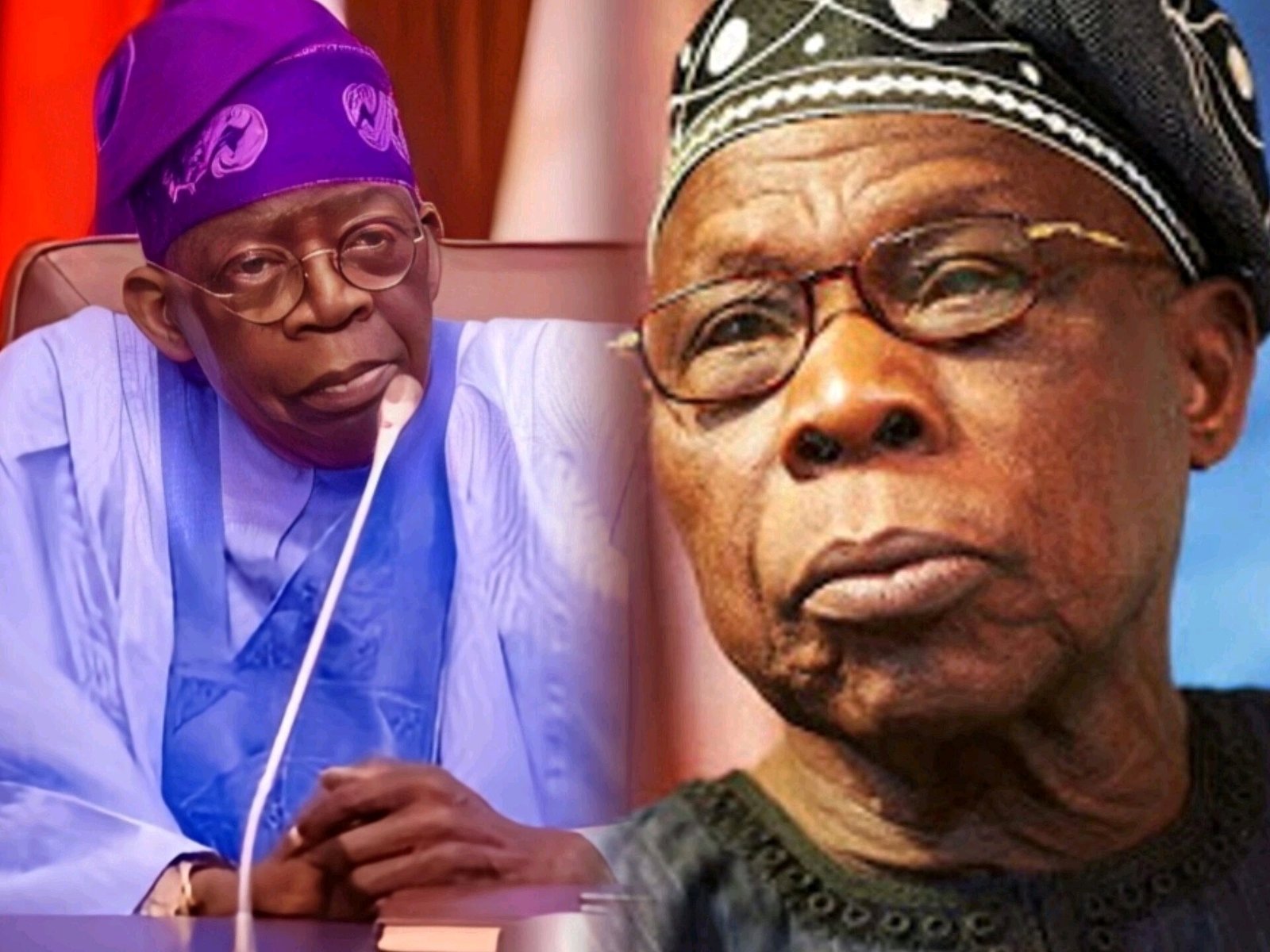
Former Nigerian President Olusegun Obasanjo has questioned whether President Bola Ahmed Tinubu deserves a second term in office, citing concerns about economic hardship and the impact of government policies on ordinary Nigerians.
According to a report by Daily Independent published on Thursday, October 22, 2026, Obasanjo challenged the argument that Tinubu should be given another four years to complete his policies and allow his administration’s reforms to produce results.
The former president questioned the justification for continuing policies that, in his assessment, have placed significant pressure on households and businesses.
“What policies are you seeing through? You impoverish your people and you want to see impoverishment through? What are you seeing through?” Obasanjo asked.
His remarks have renewed debate about the Tinubu administration’s economic record and whether policy continuity should be a decisive factor in the debate over the president’s possible re-election in 2027.
Obasanjo Questions Argument for a Second Term
Obasanjo’s comments focused on the argument that an incumbent president should be allowed to complete ongoing policies rather than have a new administration change direction.
He questioned whether extending a government’s tenure was sufficient justification for continuing its programmes when citizens were still struggling with economic pressures.
According to the report, the former president argued that government performance should be judged by the tangible improvements people experience in their daily lives, rather than by promises that policies need additional time to deliver results.
His position places emphasis on the relationship between economic reforms and public welfare, particularly the ability of Nigerians to afford food, transport, housing and other basic necessities.
The comments also touch on a central question in the debate over economic reform: whether the long-term benefits promised by policy changes justify the immediate difficulties experienced by citizens.
Ghana’s Exchange Rate Used as an Example
To support his argument, Obasanjo reportedly referred to Ghana’s exchange rate, claiming that the country’s president inherited a rate of approximately 16 cedis to the US dollar, which improved to around 10 cedis within six months.
He used the comparison to illustrate how government decisions can influence economic conditions and currency performance.
However, the exchange-rate figures and the timeframe cited in the report require independent verification before they can be treated as an accurate representation of Ghana’s economic performance.
Exchange rates are influenced by several factors, including monetary policy, foreign-exchange supply, inflation, investor confidence and broader economic conditions. A comparison between two countries therefore requires consideration of their different circumstances and the periods being examined.
Stronger Currency Can Also Create Challenges
Obasanjo also reportedly acknowledged that currency appreciation can produce different outcomes for different groups within an economy.
He referred to concerns attributed to cocoa farmers in Ghana, who allegedly appealed to their president over the effect of the stronger cedi on the prices they received for their produce.
For exporters, an appreciating domestic currency can reduce the local-currency value of foreign earnings and affect competitiveness, even though it may make imported goods cheaper for consumers.
The example highlights the need to assess economic performance beyond headline exchange-rate movements, taking into account the interests of households, businesses, farmers and other groups.
Debate Over Tinubu’s Economic Reforms Continues
Tinubu’s economic policies and their effects on Nigerians remain important issues in the debate over his administration’s performance.
Obasanjo’s remarks, as reported, challenge the argument that the president should automatically receive another term to continue his programmes. His central question is whether the outcomes of those policies justify their continuation.
Supporters of policy continuity may argue that major economic reforms require time to produce sustainable benefits. Critics, meanwhile, may insist that citizens should see clearer improvements in living standards and economic stability.
The two positions reflect a wider debate about the balance between short-term hardship and the longer-term objectives of economic reform.
What the Remarks Mean for the 2027 Debate
With Nigeria’s next presidential election scheduled for 2027, questions about economic management, public welfare and leadership accountability are likely to remain central to political discussions.
Obasanjo’s comments add to scrutiny of Tinubu’s record and challenge those advocating a second term to explain what measurable benefits Nigerians should expect from continuing the administration’s policies.
His remarks do not, by themselves, determine the outcome of the debate over Tinubu’s re-election. They do, however, reinforce the argument that a government’s performance should be assessed against its impact on citizens.
As political discussions intensify, the economic consequences of government decisions and the pace at which living conditions improve are likely to remain key considerations for voters.
ERIBS Media will continue to follow developments surrounding Nigeria’s economic policies and the debate over the 2027 presidential election.
“You Impoverish Your People and Want to See It Through?” — Obasanjo Questions Tinubu’s Second Term
More Politics


0 comment
Leave a comment