
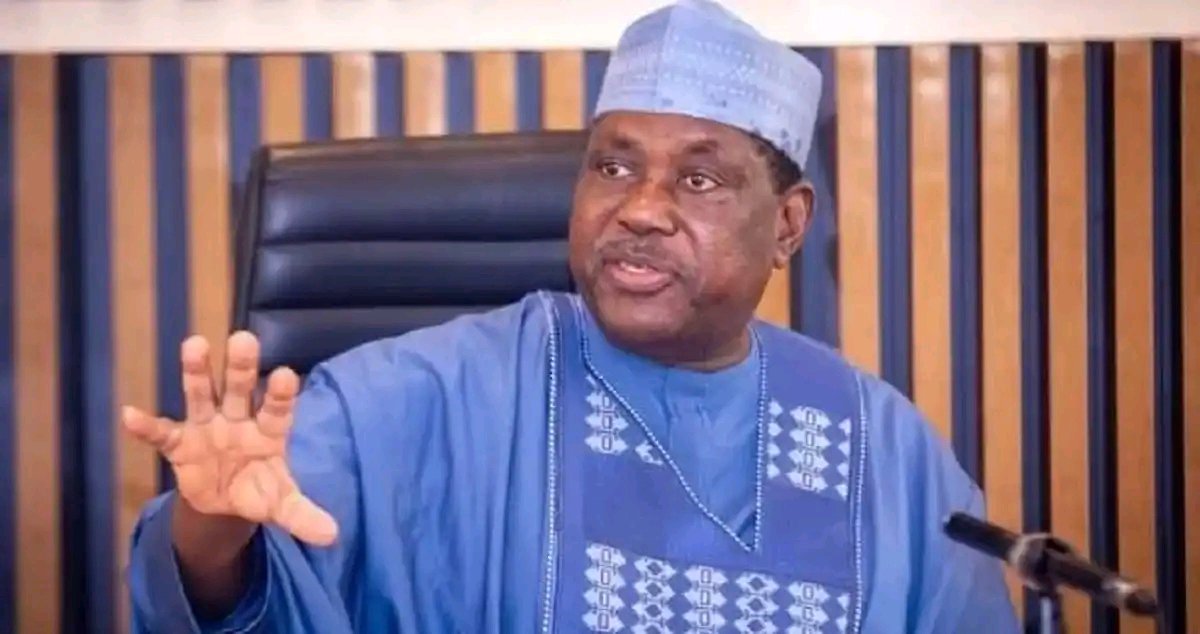
Secretary to the Government of the Federation (SGF), George Akume, has reminded Nigerians from the North of the political understanding reached in Kaduna in 1999 to promote the rotation of presidential power between northern and southern Nigeria.
Akume made the remarks during a North-Central grassroots rally organised in support of President Bola Ahmed Tinubu and Vice President Kashim Shettima on Saturday, October 10, 2026.
Speaking in an interview with Channels Television, the SGF urged northerners to take the arrangement into consideration amid discussions about political leadership and the 2027 general election.
According to Akume, the understanding reached at the end of military rule provided for eight years of presidential leadership from the South, followed by eight years from the North.
He said: “All of us are northerners but again I want us to take one thing into consideration. That we agreed in Kaduna in 1999 to ensure that power rotates between the north and the south. 8 years in the south, 8 years in the north.”
Akume Revisits the 1999 Power-Sharing Understanding
Akume's comments have brought renewed attention to the informal power-sharing convention that has influenced Nigeria's presidential politics since the return to democratic rule in 1999.
The principle of rotation, often called zoning, has been used by major political parties as a way of balancing regional interests and managing competition for the presidency.
Supporters argue that the arrangement can promote inclusion and reassure different parts of the country that they will have an opportunity to produce the nation's leader. However, the implementation of zoning has also generated debate within political parties, particularly when deciding which region should produce a candidate.
Akume's remarks frame the 1999 understanding as an important consideration for political leaders as they discuss the next presidential election.
2027 Election Debate and Regional Representation
The comments come as political discussions intensify ahead of the 2027 general election, with questions about presidential succession, regional representation and the future of power rotation attracting attention.
President Bola Tinubu, who comes from the South-West, assumed office in May 2023 after winning the 2023 presidential election. The question of which region should produce the next president has consequently become part of wider political debate.
Akume's appeal to northerners highlights the continuing relevance of zoning as a political convention. Nevertheless, the rotation arrangement is not expressly prescribed by Nigeria's Constitution; presidential eligibility and elections are governed by constitutional provisions and the electoral process.
Power Rotation Remains a Political Question
Nigeria's political parties and leaders may continue to debate how the principle of rotation should apply in 2027. Akume's statement offers his perspective on the historical understanding, but it does not by itself determine which candidate or region any party must select.
As the election approaches, discussions about zoning are likely to intersect with party nominations, regional interests and arguments about national unity and democratic competition.
ERIBS Media will continue to follow developments surrounding the 2027 election and the debate over presidential power rotation in Nigeria.



0 comment
Leave a comment